
What is aFRR?
aFRR stands for automatic Frequency Restoration Reserve, also known as secondary control reserve. It balances short-term deviations between electricity generation and consumption and helps restore the grid frequency to its target value of 50 Hz in the European interconnected system. Suitable generation assets, battery energy storage systems and consumers adjust their power based on automatic setpoints issued by transmission system operators (TSOs).
aFRR at a Glance
- aFRR is activated through external power setpoints, distinguishing it from the locally frequency-dependent Frequency Containment Reserve.
- Positive and negative aFRR describe opposite power adjustments relative to the scheduled operating point.
- Participation requires proven technical capability, reliable communication and integration into the relevant balancing market.
How Is aFRR Activated?
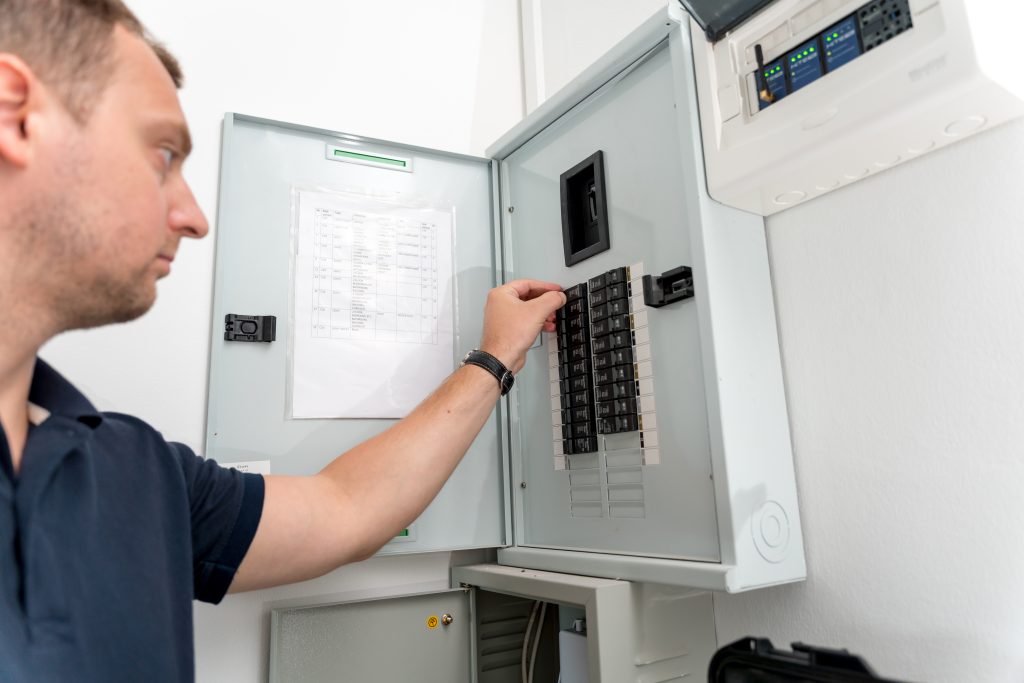
The transmission system operator determines the balancing requirement and sends automatic power setpoints to balancing service providers. If a provider combines several assets in a pool, its control system distributes the request among the participating units. These units then adjust their generation, consumption or storage power. Measurement feedback allows the actual response to be monitored.
Unlike Frequency Containment Reserve (FCR), aFRR does not respond solely to a locally measured frequency deviation. The transmitted setpoints determine the required response. In Germany, the maximum full activation time is five minutes. The specified activation profile must already be followed during the activation process.
The two directions are distinguished as follows:
| Reserve direction | Adjustment in the energy system | Battery storage example |
| Positive aFRR | Increase feed-in or reduce consumption | Discharge more or charge less |
| Negative aFRR | Reduce feed-in or increase consumption | Charge more or discharge less |
The relevant factor is the adjustment relative to the scheduled operating point, meaning the operating point without an aFRR activation. A battery can therefore provide positive aFRR while continuing to charge. In a simplified example, reducing its charging power from 200 to 100 kW represents a positive power adjustment of 100 kW.
The European PICASSO platform coordinates the cross-border activation of aFRR balancing energy. It considers available transmission capacities and facilitates the economically efficient selection of bids.
Which Assets Can Provide aFRR?
Battery energy storage systems can adjust their charging and discharging power. They are therefore generally suitable for both reserve directions, provided sufficient power and energy reserves are available.
Controllable generation assets, such as hydropower plants or suitable biogas plants, can adjust their feed-in within their operating limits.
Flexible consumers can increase or reduce their electricity consumption. For industrial processes, production schedules, minimum operating times and permitted interruptions must be considered.
What Determines Market Participation and Viability?
Participation in the balancing market requires prequalification. This process assesses factors such as control performance, power delivery, measurement data and secure communication. Smaller assets can participate together in a pool through an aggregator. The exact requirements depend on the relevant market and transmission system operator.
In Germany, balancing capacity and activated balancing energy are procured and settled separately. Balancing capacity remunerates the committed availability of power, while balancing energy refers to the energy that is actually activated. Participation in the balancing energy market is possible without a prior award in the balancing capacity market, provided the other participation requirements are met. Without an award in the balancing capacity market, however, no remuneration is paid for capacity availability.
Participation can create additional revenue opportunities for asset operators. Its financial viability depends on factors such as market prices, availability, marketing costs and additional wear on the assets.
For battery energy storage systems, the available flexibility is limited by the state of charge, usable energy capacity, charging and discharging power, and grid connection limits. Reserved capacity must not be allocated simultaneously to conflicting applications such as self-consumption optimization, peak shaving or other services. Reliable setpoint transmission, suitable measurement feedback and defined behavior in the event of communication failures are also required.
How Can EcoPhi Support the Technical Implementation?
EcoPhi can provide the